

From the beginning of history, humanity has fought countless battles. But some of them stand out—not because of who won, but because of how they were fought. One such unusual clash occurred in 1788 near Karánsebes (now Caransebeș, Romania), and it fits perfectly into the category of “strange battles.”
Between 1788 and 1791, the Habsburg Empire was at war with the Ottoman Empire. Known as the Austro-Turkish War, it was a fierce struggle in which Austria aimed to reclaim lost territory. But in one remarkable incident, the Ottomans won a battle without even being there—thanks to alcohol, confusion, and panic.
In September 1788, an Austrian army of around 100,000 soldiers set up camp near the Danube River, close to Karánsebes. This multi-ethnic army was led by the Holy Roman Emperor Joseph II and included Austrians, Romanians, Serbs from the Military Frontier, Croats, Italians, and other groups—many of whom did not speak the same language. This lack of shared communication would soon lead to disaster.
One night, a scouting party of hussars (light cavalry units) crossed the Timiș River to check for approaching Ottoman forces. They found no enemy troops, but instead encountered a group of Romanian traders selling alcohol. With no threat in sight, the scouts began drinking and celebrating by the river.
Hearing the commotion, some Austrian infantrymen crossed over to join the festivities. However, the hussars refused to share their alcohol and even built makeshift barricades around their barrels. A heated argument broke out between the two groups, and eventually, a shot was fired. Panic ensued.
During the chaos, someone shouted “Turci!” (“Turks!”), prompting the hussars to believe they were under attack. They retreated in a frenzy, regrouped with their commanders, and launched a counterattack against what they believed was the Ottoman enemy—but were, in fact, their own men.
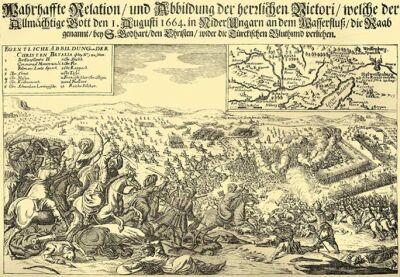
The situation spiraled even further out of control when Austrian officers tried to stop the confusion by shouting “Halt! Halt!” (German for “Stop!”). Non-German-speaking soldiers misheard it as “Allah! Allah!”—a battle cry often used by Ottoman troops—and panicked even more.
To make matters worse, General of Artillery Colloredo mistook the hussars’ charge for an Ottoman assault and ordered artillery fire. In the ensuing chaos, the Holy Roman Emperor himself eventually ordered the army to retreat.
Casualty estimates vary wildly—from 150 to 10,000 dead and wounded, depending on the source. When the actual Ottoman army arrived two days later, they encountered no resistance and captured Karánsebes with ease.
Whether the story is entirely true or part myth has been debated. Austrian Military Magazine in 1831 mentioned the incident, as did F.C. Schlosser’s 1843 work The History of the 18th Century through the 19th till the Overthrow of the French Empire. The most detailed account comes from Geschichte Josephs des Zweiten by A.J. Gross-Hoffinger, published nearly 60 years after the event. Paul Bernard also referred to it in his 1968 biography of Emperor Joseph II, describing the tragedy as a case of friendly fire.
While the exact details remain unclear, the Battle of Karánsebes stands as one of the most bizarre and tragic examples of miscommunication and friendly fire in military history.